Why Study Abroad?
English is not a second language but a native language. Let’s master English quickly in elementary school.
– The younger one is, the more rapidly one can learn a language; thus, beginning at an early age yields faster results.
– Upon mastering English in elementary school, one may devote greater attention to other subjects.
American-style education is more accessible and less burdensome than that in nearby cities, and tuition is more affordable.
– The Philippines follows the American education system and is within a four-hour flight from other Asian countries.
– Individual skill improvement is possible through one-to-one lessons, at a lower cost than in other English-speaking countries such as the United States and Canada.
Participatory education, not rote learning: Korean education system vs. Philippine education system.
– A presentation‑and assignment‑oriented teaching method, rather than a test‑oriented one, which increases confidence and strengthens self‑directed learning ability.
– Developing a mindset to participate more actively in class by answering one hundred questions repeatedly.
– Instead of discriminating against children based on merit, we provide opportunities for growth through after‑school classes for those who are lacking.
– No need for expensive private education costs for advanced learning.
Early study abroad in the Philippines, due to parents’ choice, educational environment, family circumstances, etc.
– A choice for children struggling within the Korean education system.
– Situations in which children cannot receive proper care, such as those involving single parents or dual‑income families.
– To enable students to pursue their dreams — by learning English and expanding their horizons beyond just getting into a good university or securing a good job.
Phillipine Education System
The basic education system was changed to a 12‑year system, similar to Korea’s, beginning in 2012 under the K to 12 Program.
– Previously: 6 years of elementary school + 4 years of high school.
– After the change: 6 years of elementary school + 6 years of secondary (middle and high school), for a total of 12 years.
– Public schools: state‑run, typically use Tagalog (and other local languages), and generally do not have many — if any — Korean students; tuition is free.
– Private schools: attended mostly by children from wealthier families; classes are usually conducted in English, except for Tagalog (the native language).
– International schools: serve foreign children residing in the Philippines; all classes are taught in English.
Semester System
– Private schools: open in June; vacation follows in April–May.
– International schools: classes begin in August; vacation occurs in June and July.
Admission and preparation period: at least 2–3 months of preparation before admission.
– For those with prior language‑training experience or with an intermediate or higher level of English: after 2–3 months of ESL preparation, audit classes and then enroll
– For those without prior language‑training experience, or whose English is below beginner level: after 3–6 months of ESL preparation, audit classes and then enroll.
Transfer period: August (1st semester), January (2nd semester)
– Private/International schools: Philippine schools usually operate on a four‑quarter system, and the start of the semester may differ from that in Korea.
*Because each school has different admission requirements, please check the information of the school you wish to apply to in advance (document preparation may be required)
B.E.L.A의 관리형 조기 유학
– We manage everything, from study habits to proper lifestyle and dietary habits.
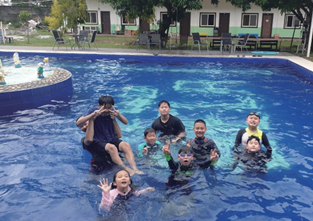
– The academy offers recreational facilities for children — including a basketball court, badminton court, swimming pool, and library.
– We provide pick‑up and drop‑off services for commuting.
(Westfield International School: 1 minute by car; Noblesse International School: 5 minutes by car)
– School counseling for children is available through guardian visits.
– We provide continuous learning planning and management via a 1:1 after‑school tutoring system, offering 2–3 one‑on‑one tutoring sessions on weekdays after school.
– Daily Korean‑style mathematics instruction with a Korean teacher helps improve students’ math grades.
– Ongoing consultations for life and career planning are available.
– Preparation for middle‑ and high‑school equivalency examinations is possible.
– Students can also prepare for college admissions by participating in volunteer activities (e.g., helping underprivileged local communities or orphanages within the Korean community).
– We help manage and support the student’s long‑term vision for the future.
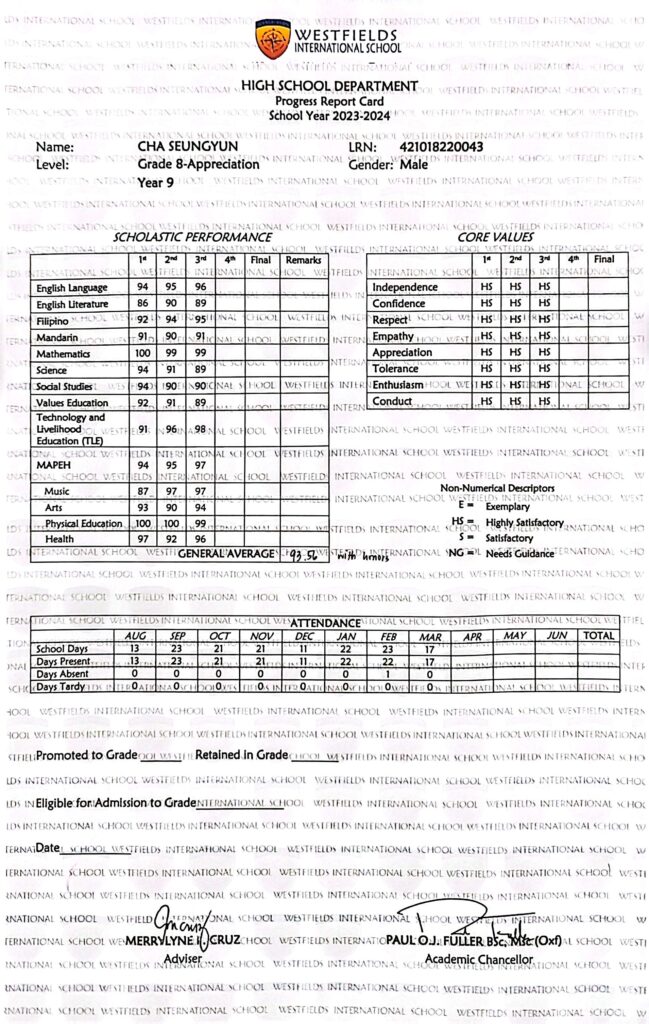
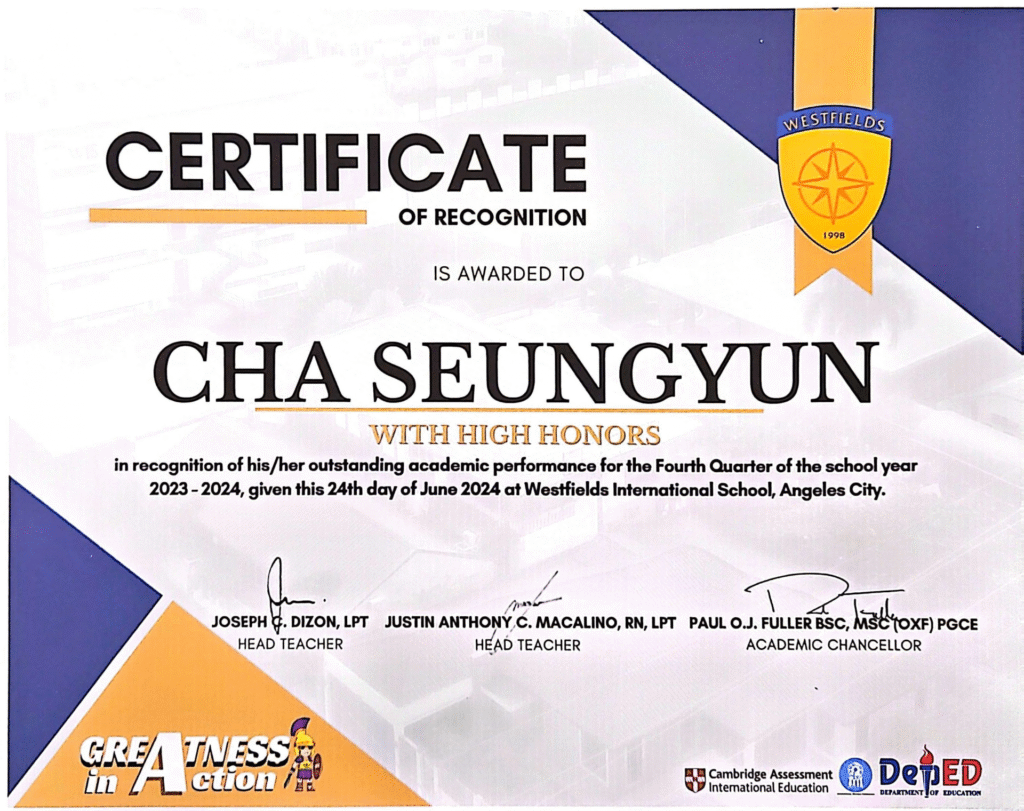
GPA Performance Management
Memorize words/patterns in the following sequence, and build solid skills by reviewing each list 2–3 times:
Basic 1 ▶ Basic 2 ▶ Middle‑School Basics ▶ Middle‑School Basics ▶ High‑School Vocabulary ▶ IELTS Vocabulary ▶ TOEFL Vocabulary ▶ SAT Vocabulary.
(Submit homework by writing sentences using the memorized words — the teacher will provide editing guidance.)Copy school textbooks and, in a one‑on‑one tutor setting, preview, review, and complete homework every day.
During exam periods, review with your teacher what you have learned so far.
After completing ESL studies, systematically study vocabulary, reading, writing, listening, and speaking for IELTS or TOEFL.
Write a weekly essay (at least 30 lines) on a TOEFL topic, then receive direct editing and guidance from the head teacher.
A Korean‑language teacher instructs mathematics up to middle‑school grade 3 using Korean textbooks (overall average math GPA is A or higher).